As someone who has spent years refining search strategies, I’m often asked about the real difference between semantic search vs keyword search. This question has become even more important with Google’s shift toward AI-driven understanding, SGE (Search Generative Experience), and natural-language interpretation. In this article, I break down everything I’ve learned as a practitioner—how semantic search works, how keyword search still plays a role, and how I optimize content for both systems in 2025.
To fully understand this topic, you must look at search engines the way Google views them today—through concepts like keyword prominence, keyword proximity, semantic relationships, natural-language intent, and EEAT principles.
Table of Contents
- Introduction: Why This Comparison Matters
- What Is Keyword Search?
- What Is Semantic Search?
- Semantic Search vs Keyword Search: The Core Difference
- How Search Evolved From Keywords to Semantics
- How This Impacts SEO in 2025
- Real Examples: Keyword Search vs Semantic Search Queries
- Semantic Search in the AI Era (SGE, ChatGPT, Perplexity)
- How I Optimize for Semantic Search & Keyword Search
- Final Thoughts
Introduction: Why Comparing Semantic Search vs Keyword Search Matters
Search in 2025 is dramatically different from what we worked with ten, even five years ago. When clients ask me how semantic search vs keyword search differs, my answer is simple:
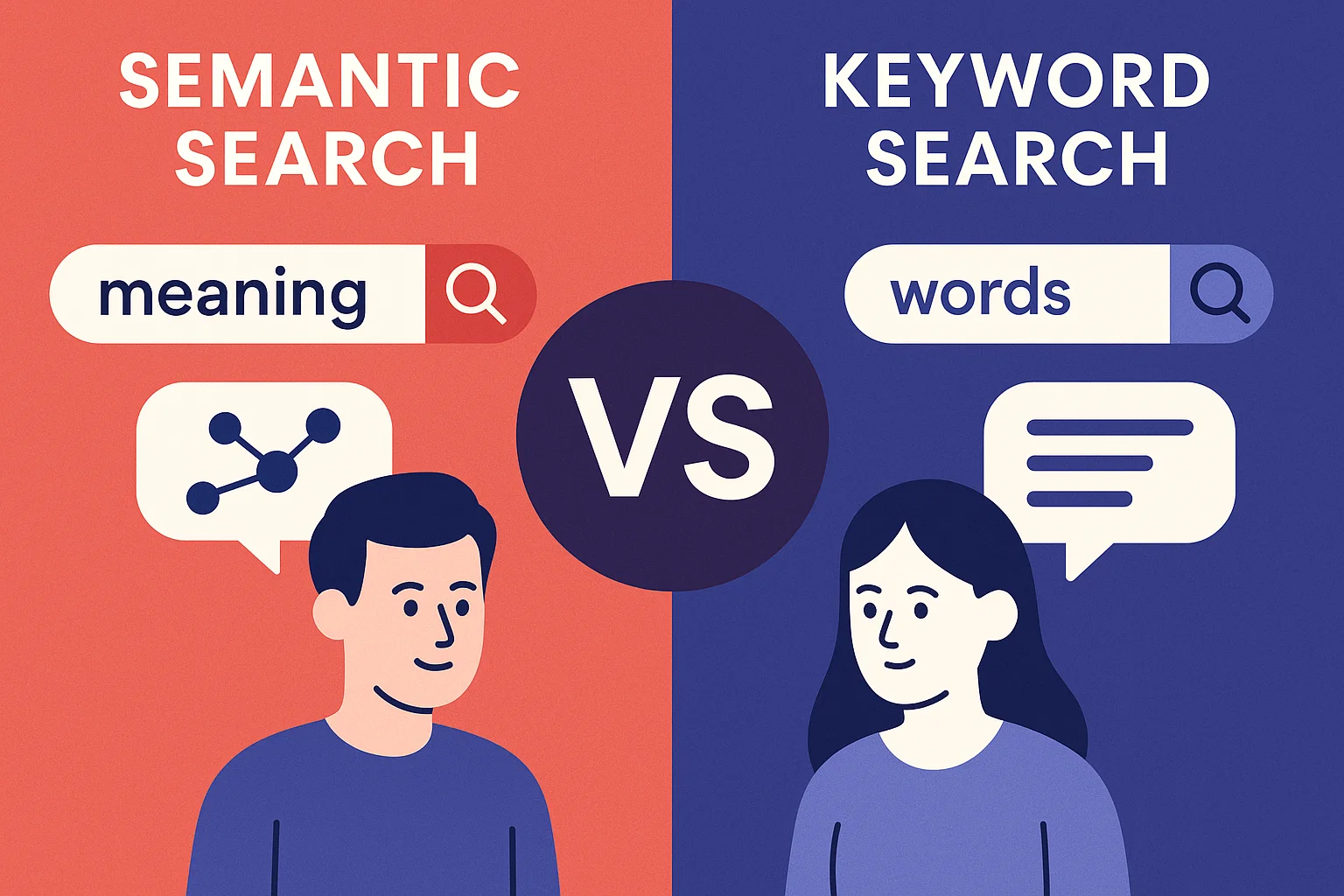
Keyword search focuses on matching words. Semantic search focuses on understanding meaning.
Google, Bing, and AI systems now interpret context, relationships, intent, and entities—not just literal terms. Understanding this shift helps me create content that performs well across SGE, ChatGPT Search, and traditional SERPs. However, keyword search isn’t dead; it’s simply no longer the center of the search universe.
What Is Keyword Search?
Keyword search is the traditional search model used by early search engines. When a user types specific words into a search bar, the engine attempts to match those keywords in titles, headings, meta tags, URLs, and content.
Keyword search relies heavily on techniques like:
- keyword density
- keyword stuffing (now outdated)
- exact-match phrasing
- keyword placement
This is why concepts like keyword prominence played an essential role in early SEO and still matter today for contextual clarity.
For a foundational understanding of SEO basics, I recommend reading What Is SEO?.
What Is Semantic Search?
Semantic search is how modern search engines understand meaning instead of literal text. With advancements such as BERT, MUM, RankBrain, and machine learning, Google now interprets:
- user intent
- contextual signals
- entities and relationships
- natural-language patterns
- searcher behavior
Semantic search focuses on providing the most relevant answer—not the page with the most matching keywords. It understands synonyms, concepts, and relationships.
This is why when a user searches “best places to eat near me,” Google understands “places to eat” means restaurants, even if the content never uses that exact phrase.
Semantic Search vs Keyword Search: The Core Difference
The easiest way I explain the difference is this:
Keyword search = literal matching. Semantic search = meaning matching.
Key Differences
| Keyword Search | Semantic Search |
|---|---|
| Matches exact keywords | Understands meaning & intent |
| Rigid; depends on phrasing | Flexible; recognises synonyms & context |
| Rewards keyword frequency | Rewards topic depth and clarity |
| Focuses on keyword placement | Focuses on semantic relationships |
| Older search engine technology | Current AI-driven approach |
Semantic search is simply more efficient, user-friendly, and aligned with how human language works.
How Search Evolved From Keywords to Semantics
Google’s shift began years ago with:
- Hummingbird (context focus)
- RankBrain (machine learning)
- BERT (natural language understanding)
- MUM (multi-modal reasoning)
This evolution made keyword search alone insufficient for ranking. AI-friendly, context-rich content is now essential.
Google’s Search Essentials also emphasise clarity, helpfulness, and intent satisfaction—core principles of semantic search.
How This Impacts SEO in 2025
In 2025, SEO is no longer just keyword placement. It’s about proving expertise, clarity, and contextual understanding. That’s why I incorporate principles like:
- EEAT (Expertise, Experience, Authority, Trust)
- topical authority
- semantic relationships
- entity optimization
Google and AI systems evaluate how well your content fits within a broader topical cluster—not whether it contains the exact keyword repeatedly.
Real Examples: Semantic Search vs Keyword Search Queries
Example 1: Keyword Search
Query: “best pizza New York cheap” Older search engines would match pages containing these exact words.
Example 2: Semantic Search
Query: “affordable pizza near Times Square” Google infers:
- “affordable” ≈ “cheap”
- “New York” contains Times Square
- intent = someone searching for low-cost pizza nearby
Semantic search delivers more precise results even when keywords don’t match exactly.
Semantic Search in the AI Era (SGE, ChatGPT, Perplexity)
AI systems like Google SGE, Bing Copilot, ChatGPT Search, and Perplexity rely heavily on semantic analysis. They:
- interpret user context
- summarize content
- extract meaning, not keywords
- evaluate factual accuracy
- recommend entities with strong EEAT
In this environment, keyword search becomes almost irrelevant unless supported by semantic clarity.
How I Optimize for Semantic Search & Keyword Search
Here’s the exact framework I use to optimize content for both semantic search and keyword search:
1. Start With Topic Clusters
I ensure content belongs to a structured cluster with related topics, entities, and supporting articles. This boosts overall authority.
2. Use Keywords Naturally (Not Excessively)
I maintain healthy keyword density and proximity without sounding forced—an essential aspect of modern SEO.
3. Write for Human Understanding First
AI rewards clarity, logic, and context—not keyword repetition.
4. Add Internal Links to Reinforce Context
Internal links signal topical relevance and help AI understand relationships. Throughout this article, I included links to foundational SEO concepts like:
5. Incorporate External Authority
I reference trusted sources like Moz SEO Library to increase credibility.
6. Optimize for AI Interpretation
I structure content so that SGE, Perplexity, and ChatGPT can easily parse, summarize, and cite it.
Final Thoughts
When comparing semantic search vs keyword search, what I’ve learned is this:
Keyword search still matters for clarity and indexing. Semantic search matters for relevance and AI-driven interpretation.
If you want to succeed in 2025 and beyond, your strategy must embrace both. But if you must prioritize one, prioritize semantic search—it reflects how modern search engines and AI systems understand the world.
In other words: write content that makes sense to humans and machines, not just algorithms.
FAQ: Semantic Search vs Keyword Search
1. What is the difference between semantic search and keyword search?
Keyword search focuses on matching exact words, while semantic search understands context, intent, and the relationships between terms. Semantic search delivers more accurate and meaningful results because it interprets what the user really wants, not just the words typed.
2. Why is semantic search important in 2025?
Semantic search is crucial in 2025 because Google SGE, ChatGPT Search, Bing Copilot, and Perplexity all rely on intent-based understanding. These AI-driven systems reward content that is clear, contextual, and semantically rich rather than content stuffed with keywords.
3. Does keyword search still matter today?
Yes, keyword search still plays an important role. Search engines use keywords for indexing, clarity, and categorization. However, keywords now work best when supported by semantic relevance, natural-language structure, and well-developed topical authority.
4. How do I optimize for semantic search?
To optimize for semantic search, focus on topic depth, entity optimization, natural phrasing, and internal linking to related content. Write helpful, logically structured explanations that AI systems can easily interpret and summarize.
5. Is semantic search better than keyword search?
Semantic search is more advanced because it understands meaning and intent, making it more aligned with how modern AI systems operate. However, both approaches work together. Effective SEO requires using keywords strategically while prioritizing semantic clarity.

![Top Safety Devices for Seniors Living Alone [Updated 2024]](https://www.blogneews.com/wp-content/uploads/2024/09/eberhard-grossgasteiger-iIFLDQmXPiw-unsplash-120x86.jpg)