New England is often photographed in daylight. Travel images emphasize white church steeples, weathered coastal houses, village greens, mountain roads, red barns, and harbors filled with boats. These places are beautiful in the sun, but their character changes after dark.
The landscape recedes. Historic windows begin glowing. Strings of lights appear against trees, music travels farther through the evening air, and spaces that felt picturesque during the day become intimate at night.
For celebrations, that transformation matters. A venue is not simply a fixed background. It changes as the hours pass, giving the event a natural progression that would be difficult to reproduce with decorations alone.
Evening makes old buildings feel inhabited again
New England contains countless inns, estates, barns, mills, hotels, and meeting halls that have outlived their original purposes. During the day, visitors notice their construction: timber framing, brick walls, narrow windows, wide floorboards, or carefully preserved trim.
At night, attention shifts to what is happening inside them.
Warm light softens the architecture. Rooms begin to feel less like historic objects and more like living spaces. Music and conversation return human activity to buildings that may have hosted gatherings for generations.
This does not require an elaborate historical theme. Contemporary clothing, modern music, and new traditions can exist comfortably inside an old structure. The contrast is part of the appeal.
The building contributes continuity, while the people inside it create something temporary.
Coastal darkness has its own atmosphere
A coastal celebration changes quickly after sunset. Water that provided a broad scenic view during the day becomes a dark, reflective surface. The horizon becomes less visible, while nearby lights appear brighter and more isolated.
The air may cool even after a warm afternoon. Wind becomes more noticeable, and guests move closer to sheltered terraces, tents, or interior rooms. The celebration begins to feel physically smaller, even though the surrounding landscape has not changed.
This compression can create intimacy. People gather around light, music, and conversation while the coast becomes a quiet presence beyond them.
The ocean does not need to remain fully visible to influence the atmosphere. Its sound, temperature, and movement continue shaping the experience after the photographs of the sunset are finished.
Mountain settings become quieter and more dramatic
Inland and mountain venues undergo a different transformation. Hills and tree lines that dominated the daylight view gradually disappear. The sky may seem larger, while the occupied area around the venue becomes more clearly defined.
Outdoor lights take on greater importance because there may be little ambient illumination nearby. A porch, firepit, pathway, or tent can feel like a small island in a much larger landscape.
Sound also becomes more noticeable. Conversation, laughter, and live music stand out against the quieter surroundings. Guests become aware that the celebration is happening somewhere removed from ordinary urban activity.
This sense of separation can make an evening feel unusually complete. The outside world seems distant, allowing the gathering to establish its own rhythm.
Autumn is only one version of New England
Autumn receives much of the attention, and understandably so. Changing leaves, cool air, and early sunsets create a setting that feels naturally ceremonial. Yet every New England season changes the character of an evening in a different way.
Spring brings longer daylight, flowering trees, and weather that can shift unexpectedly. Summer evenings invite outdoor cocktails, open doors, coastal air, and celebrations that continue well after sunset. Winter places greater emphasis on interiors, fireplaces, candlelight, formal clothing, and the contrast between cold streets and warm rooms.
The season influences more than the color palette. It affects how guests move, where they gather, how long they remain outside, and when the event begins to feel like nighttime.
A summer celebration may transition gradually. A late-autumn or winter event can change character in minutes as daylight disappears.
Music becomes more physical at night
During the day, music often shares attention with the setting. Guests are looking at gardens, water, architecture, and the activity around them. After dark, sound becomes a stronger organizing force.
People can hear where the energy is coming from. The performance area becomes visually prominent, and rhythm begins defining the room more clearly than the scenery outside it.
Live music can make this transition feel immediate. A restrained cocktail-hour performance may suit the remaining daylight, while a stronger rhythm later in the evening can signal that the gathering has entered a new phase.
Couples searching for the best live wedding band in Boston are often looking for this ability to shape the atmosphere, not simply a list of recognizable songs. The performers must understand how a room changes and how to move guests with it.
At night, the combination of sound, light, and collective attention can make even a familiar room feel transformed.
Candlelight works because darkness is allowed to remain
Effective evening lighting does not attempt to make midnight resemble noon. Its purpose is to reveal the people and spaces that matter while allowing some darkness to remain.
Candles, fireplaces, chandeliers, lanterns, and warm string lights create smaller zones of attention. Faces appear more clearly than distant walls. Tables feel separate but connected. Architectural details emerge selectively rather than demanding equal attention.
This unevenness gives a room depth. Bright, uniform lighting may be practical, but it can remove the sense of transition that makes an evening feel special.
Historic New England spaces often respond particularly well to warm light because their materials already contain visual texture. Wood, stone, brick, plaster, and aged metal reflect light differently, creating an atmosphere that feels layered rather than newly installed.
Weather becomes part of the memory
Weather is often discussed as a problem to control, but it can also become one of the most memorable parts of an event.
A sudden summer shower may bring everyone under a porch. Early snow can make a warm interior feel more welcoming. Fog may obscure a coastal view while creating an unexpectedly dramatic background. Cool autumn air can make guests appreciate the first moment they step inside.
Of course, severe weather requires practical preparation. Romantic ideas about rain lose their appeal when guests are uncomfortable or equipment is exposed. Yet when basic needs are handled, imperfect weather can give the celebration a character that a perfectly neutral day would not have provided.
People often remember the atmosphere more vividly because it could not have been scheduled.
Historic cities offer another kind of darkness
In Boston, Providence, Portsmouth, Portland, and smaller historic centers throughout the region, night does not erase the surroundings. It edits them.
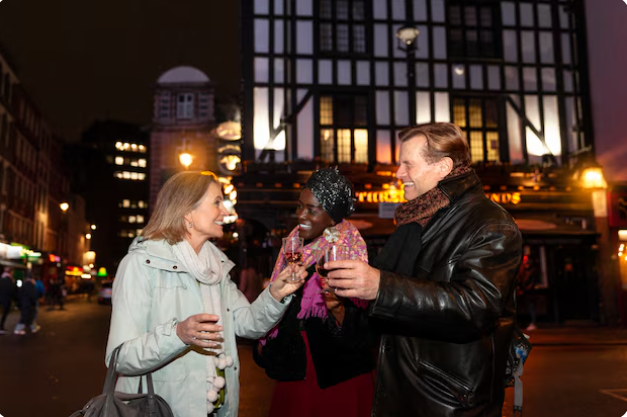
Streetlights reveal brick sidewalks, narrow streets, stone facades, and fragments of older architecture. Restaurants and hotels glow at street level while upper floors become dark. Guests moving between locations remain connected to the city without experiencing its daytime pace.
An urban celebration can therefore feel intimate without being isolated. The city continues around it, but only selected parts remain visible.
This creates opportunities for photographs and informal moments that would feel very different during the day. A short walk between a ceremony and reception, a conversation outside a hotel, or a final group leaving together can become part of the story of the evening.
Darkness makes the gathering feel temporary
Daylight shows everything around an event. Darkness narrows attention to what has been illuminated, occupied, and shared.
This gives celebrations a temporary quality. The room glows for several hours, music fills it, and people create a small world together. Later, the lights are turned off, equipment is removed, and the venue returns to its ordinary state.
New England settings make this contrast especially visible because the surrounding landscapes and historic structures possess such strong daytime identities. After dark, familiar places reveal another character.
The coast becomes sound and cool air. Mountains become silhouettes. Old buildings become warm interiors. Cities become windows, streetlights, and fragments of brick.
The celebration does not merely continue after sunset. It becomes a different event, shaped by darkness, music, and the people who remain inside the light.